
Nostalgia Marketing - Why the Past Sells the Future
Somewhere between a discontinued snack and a childhood cartoon, brands discovered something that no algorithm has been able to replicate: the past converts. Not because people want to live there, but because memory makes trust feel immediate. In a marketplace where consumers are overwhelmed with choices and underwhelmed by most advertising, nostalgia marketing cuts through because it does not ask anyone to believe something new. It reminds them of something they already know.
That is a fundamentally different proposition from almost every other strategy in a modern digital marketing strategy. And it is working harder than ever.
What Nostalgia Marketing Does to Attract Consumers?
Nostalgia marketing is the deliberate use of references, visuals, sounds or language from the past to lower a consumer's psychological resistance in the present. It is not sentimentality for its own sake. It is a calculated trust mechanism.
Ivey Business School Professor of Marketing June Cotte explains it precisely: nostalgia is a mixed emotion, part happiness, part longing, that people instinctively reach for when they feel anxious or uncertain about the present. Canadian consumers right now are navigating inflation, economic tension and an advertising environment so saturated that most messages do not register at all. Nostalgia cuts through that noise because it bypasses scepticism entirely. You do not need to convince someone to trust a memory they already hold.
This is why nostalgia is so popular among brands right now. Research confirms it measurably increases purchase intent, overall consumer spending and even prosocial behaviour. It is one of the few strategies that converts before a single product claim is made. As per our team at Boomrng, brands running outdoor advertising campaigns during culturally nostalgic moments consistently outperform those who treat the moment as background noise.
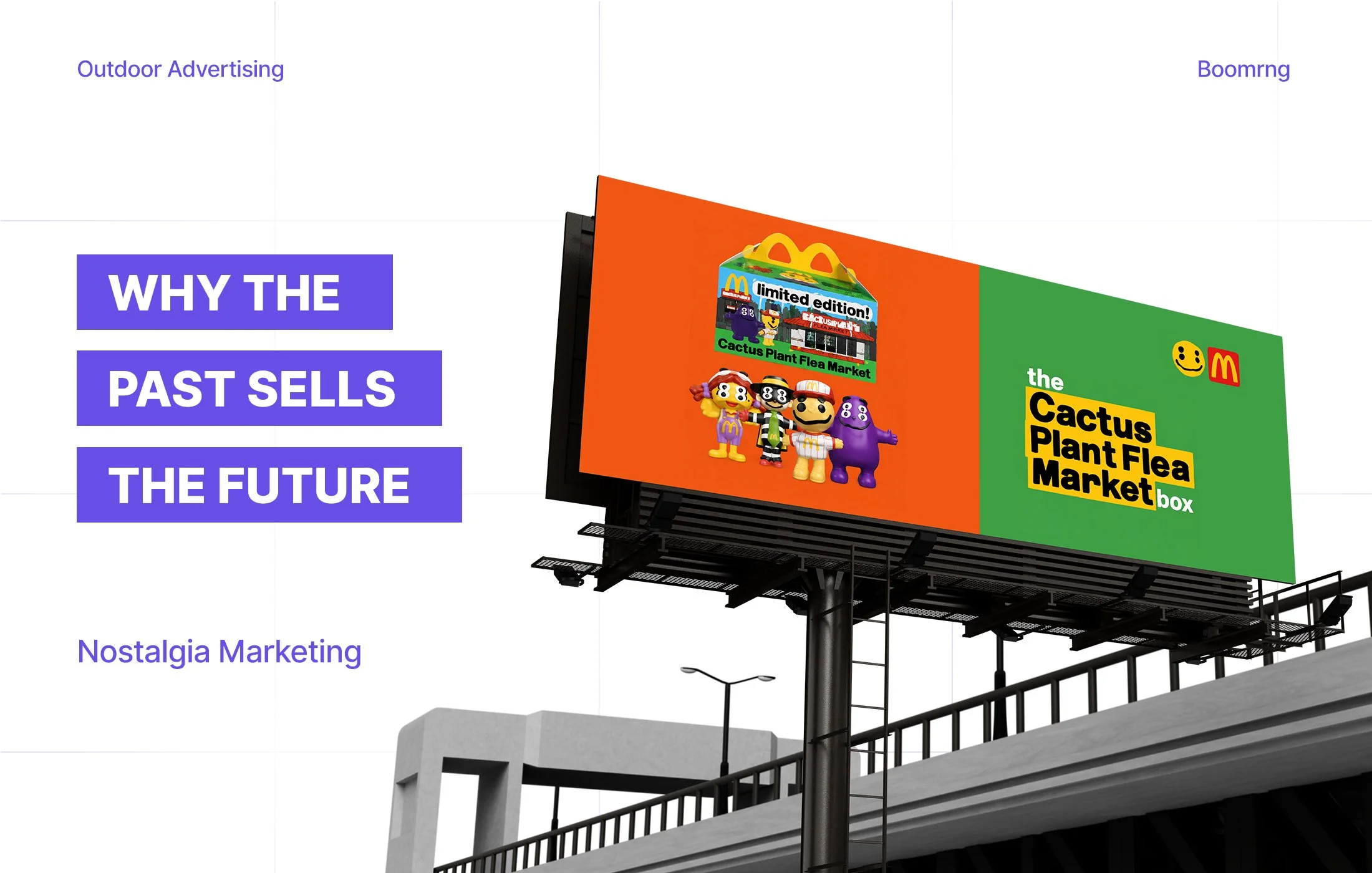
Example: The McDonald's Adult Happy Meal!
In 2022, McDonald's launched the adult Happy Meal in partnership with streetwear brand Cactus Plant Flea Market. On the surface, it looked like a brand collaboration. Underneath it was a precision nostalgia marketing exercise aimed at Millennials who grew up eating Happy Meals on Saturday afternoons.
The campaign did not try to recreate childhood. It acknowledged it with enough self-awareness that adults felt seen rather than pandered to. That single distinction is what separated it from nostalgia washing. The result was the highest single-day sales spike for a promotional item McDonald's had recorded in years. Social conversation ran for weeks without a dollar of paid amplification.
What it proves is not that nostalgia sells toys. It proves that brand engagement spikes when a brand demonstrates it understands who its audience has become by honouring who they used to be. The creative was minimal. The emotional intelligence behind it was not.
Now apply that logic to a digital billboard on a commuter route in Toronto. You have four seconds. A visual reference that connects to something your audience already carries in their memory does not need to explain itself. It lands before the rational brain has a chance to evaluate it. That is not a creative shortcut. That is the whole strategy. Brands that work with Boomrng to build seasonally and culturally timed outdoor campaigns are using exactly this mechanic, on the screens and in the markets where their audience is physically present every single day.
Why Nostalgia Washing Can Also Kill Brands?
Not every attempt at nostalgia marketing earns the response McDonald's got. The failure mode has a name now: nostalgia washing. It happens when a brand borrows the aesthetic of an era it has no authentic connection to, or when the nostalgic hook raises expectations the actual product or experience cannot meet.
Stagnation is the quiet version of the same problem. A brand that leans on its heritage without evolving what it offers is not using nostalgia as a bridge. It is using it as a hiding place. Consumers feel that gap faster than any focus group will tell you.
The brands that get this right ask a specific question before any creative advertising decision is made: what does our audience already believe about us that we can honour? That question keeps the nostalgia tethered to something real. It is the difference between a campaign that generates genuine brand engagement and one that generates a single week of social media irony at the brand's expense.
For a business considering its first advertising campaign on outdoor screens, this principle matters immediately.Our approach to billboard placement at Boomrng across BC, Alberta and Ontario is built around understanding who the audience is before a single screen is booked. That same rigour applies to creative strategy.
Build a Campaign That Earns Trust Before It Asks for a Sale!
Nostalgia marketing works in outdoor advertising specifically because the medium itself carries inherent credibility. A billboard is physical, permanent and place-specific in a way that a social ad simply is not. When the creative on that screen references something the audience already trusts, the two forms of credibility compound.
Great billboard ads do not need nostalgia to work. But when the creative is built around a memory the audience holds, the four seconds of attention it earns does the work of a much longer conversation.
Boomrng works with small and medium businesses across Canada to get campaigns live within 48 hours, with no long contracts and no agency overhead. If this is your first campaign with Boomrng, the first ad creative is designed at no charge. You bring the brand story. Boomrng handles the screens, the design and the weekly reporting.
Put your brand in front of the right Canadian audience. Start your first campaign with Boomrng.