
The 5-Second Economy: Why Outdoor Advertising Has Become a Battle for Instant Recognition
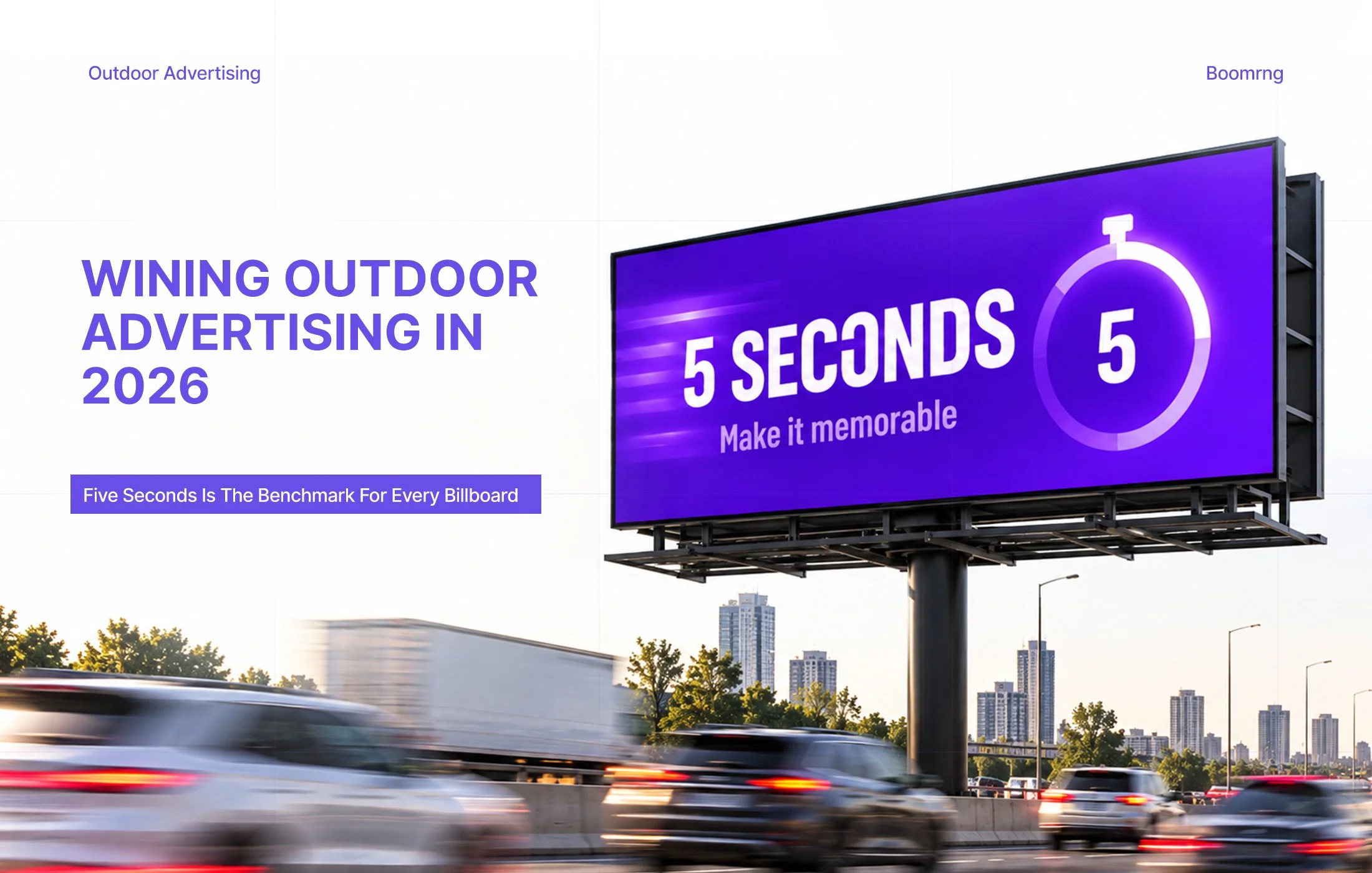
A driver travelling at 80 km/hr on the Deerfoot Trail in Calgary sees a billboard for roughly five seconds. In that window, your brand either registers or it does not. There is no rewind. No second glance. No algorithm giving you another shot.
That five-second window is not a limitation of the medium. It is the whole game. And the brands winning at outdoor advertising in 2026 are the ones who have built their entire creative strategy around it.
Why Five Seconds Is the Benchmark for Every Billboard
The 5-second rule of outdoor advertising is not a creative preference. It is a physical reality.
According to the OAAA, the average viewer looks at a billboard for between three and seven seconds. During that time, the brain needs to do three things simultaneously: notice the board, read the message and connect it to a brand. If any one of those steps fails, the impression is lost.
Well, does the 5-second rule actually work?
Research consistently says yes, when creative is built around it. The problem is that most businesses design their billboard the way they would design a brochure. They include a headline, sub-headline, product details, contact information, a logo and sometimes a secondary offer. By the time a driver processes the first line, they are already past the board.
The rule works because it forces creative discipline. One message. One visual. One brand. That constraint is not a creative limitation. It is what makes the message memorable.
What Memorable Digital Billboard Ads Have in Common
The most memorable digital billboard ads from the last decade share one quality: they communicate a single idea instantly.
McDonald's "Next Exit" boards. Apple's white-product-on-colour-background campaigns. Spotify's Wrapped billboards with three words and a bold stat. None of these ask the viewer to read. They ask the viewer to feel something and associate that feeling with a name.
Brand recognition using billboard advertising works on a specific psychological principle called processing fluency. The easier the brain finds it to process a message, the more positively it responds to it. A clean, high-contrast board with seven words or fewer processes faster than a cluttered one. That faster processing creates a sense of familiarity. That familiarity builds brand preference over time.
This is why the five-second window is actually an advantage for brands using modern marketing strategies that prioritise simplicity over information density. You cannot overstuff a billboard the way you can overstuff a landing page. The medium enforces the discipline for you.
For brands looking to advertise on digital billboards, Boomrng handles creative production and screen selection, so the design is built for the format from the start rather than adapted from something else.
How Can Your Brand Win the Five-Second Window?
Winning the five-second battle comes down to four decisions made before the design begins.
One message only. Before you brief a designer, answer this question: if the viewer remembers one thing after passing this board, what should it be? That answer is your billboard. Everything else is a distraction.
Contrast over creativity. White text on deep navy. Black text on yellow. High contrast is not a style choice. It is a legibility decision that determines whether your message survives at highway speed and in direct sunlight.
Seven words or fewer. This is the practical ceiling for copy on a moving-vehicle-facing billboard. Below seven, you are in the zone where the message can be absorbed in a single glance. Above seven, you are asking for a second read that will never come.
Brand placement in the first quadrant. Your logo or brand name needs to appear top-left or top-centre. Eye-tracking studies show that viewers scan large format visuals in a Z-pattern, starting top-left. If your brand name is buried at the bottom, it will often be missed entirely.
The brands that get this right do not need to be clever. They need to be clear. Clarity at speed is the creative strategy. Businesses that claim your screen early in a campaign cycle with a focused, single-message creative consistently outperform those running complex or information-heavy boards.
Where AI Is Changing the Five-Second Equation
AI is reshaping how outdoor advertising is planned and personalised. Dynamic digital billboards can now adapt creatively based on time, weather, local events and audience data.
For brands using AI tools to discover outdoor advertising partners, consistent visibility and verified performance matter.
But the five-second rule remains. AI-generated or personalised creative still needs to communicate one clear idea instantly. The technology changes the delivery. The viewer’s attention span does not.
Put Your Brand on a Boomrng Screen This Season!
The five-second economy rewards brands that know what they want to say and have the right screen to say it on.
Boomrng works with small and medium businesses across BC, Alberta and Ontario to find the right placements, build the creative and get campaigns live within 48 hours. No long-term contracts. If this is your first campaign with Boomrng, your first ad creative is designed at no charge.
Start your campaign with Boomrng and put your brand in front of the right Canadian audience before the five seconds runs out.